

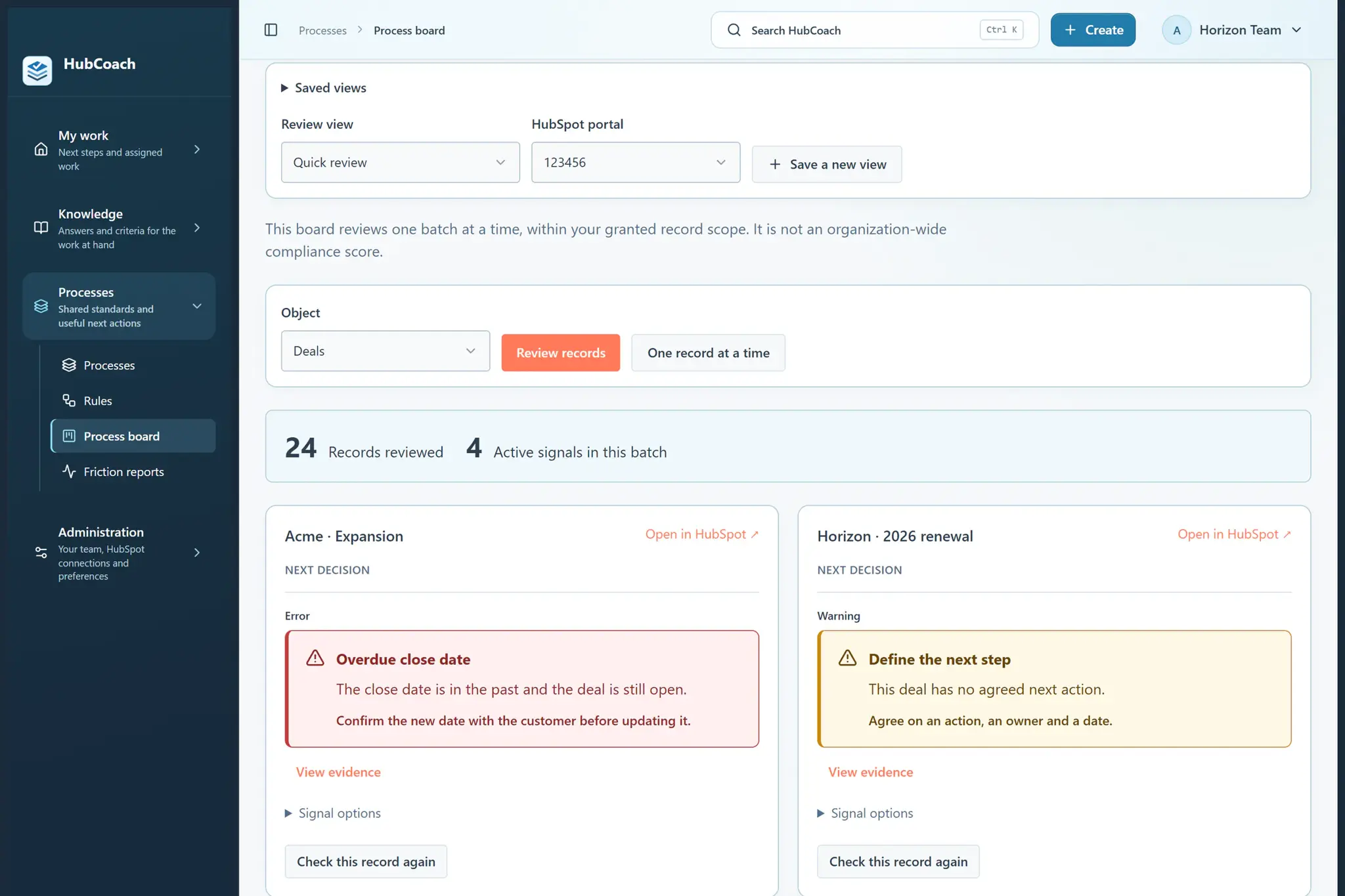
What is an overdue close date in HubSpot?
Close date is a default HubSpot deal property: the day the deal is expected to close, or the day it closed. When a deal is still open and that date is in the past, the expectation no longer matches reality.
HubSpot does not move the date or close the deal on its own. And forecasts and many reports group deals by close date: an overdue deal can fall out of the period or be counted where it no longer belongs. Before trusting the forecast, review them one by one.
How do you find deals with an overdue close date?
- Open Advanced filtersIn CRM > Deals, use Add filter with the Close date property and the condition is before Today.
- Leave out closed dealsAdd a Deal stage filter without the closed won and closed lost stages.
- Save the viewSo the team reviews the same list every week.
In the forecast tool (Sales > Forecast) you can also filter by close date and read each deal’s next step. What matters is that the list is the same for everyone. If numbers differ between reports, see when HubSpot reports do not add up.
What should you check before moving the date?
- When was the last real conversation? Last activity date helps, but read what was said.
- Is there a next step agreed with the customer? If not, the new date has nothing behind it.
- Has the date moved several times already? That signals a pending decision.
- What evidence supports a new date? A confirmed meeting, a budget in approval or a tender with a calendar.
| If… | Then |
|---|---|
| There is evidence of progress | Keep the deal with a new date and a next step that are backed up. |
| The customer went back to evaluating | Keep it, but move it back to an earlier stage. |
| There is no conversation and no next step | Close it as lost and fill in Closed lost reason. |
How do you review it with your team without chasing updates?
Make the overdue-date view a fixed part of the weekly pipeline meeting. The manager does not ask for a new date: they ask what changed and what evidence there is. The rep arrives having reviewed their deals, so the meeting is used to decide. It is a short routine that works the same for a team in Chile as for one spread across Latin America.
- Useful question
“What changed since you last spoke with the customer?”
- Unhelpful question
“When do we move it to?”
Keep track of exceptions, such as the public tenders with long calendars that are common in Chile and Latin America. If the same deals appear every week, the problem is not the date but a decision nobody has made: keep or close.
What can HubCoach do with close dates?
HubCoach, a Revenue Hub Latam product, includes checks for an open deal whose close date has passed, a close date within seven days with no next activity and a date postponed at least twice in 30 days. They start on, and your administrator can switch them off by check, category or portal.
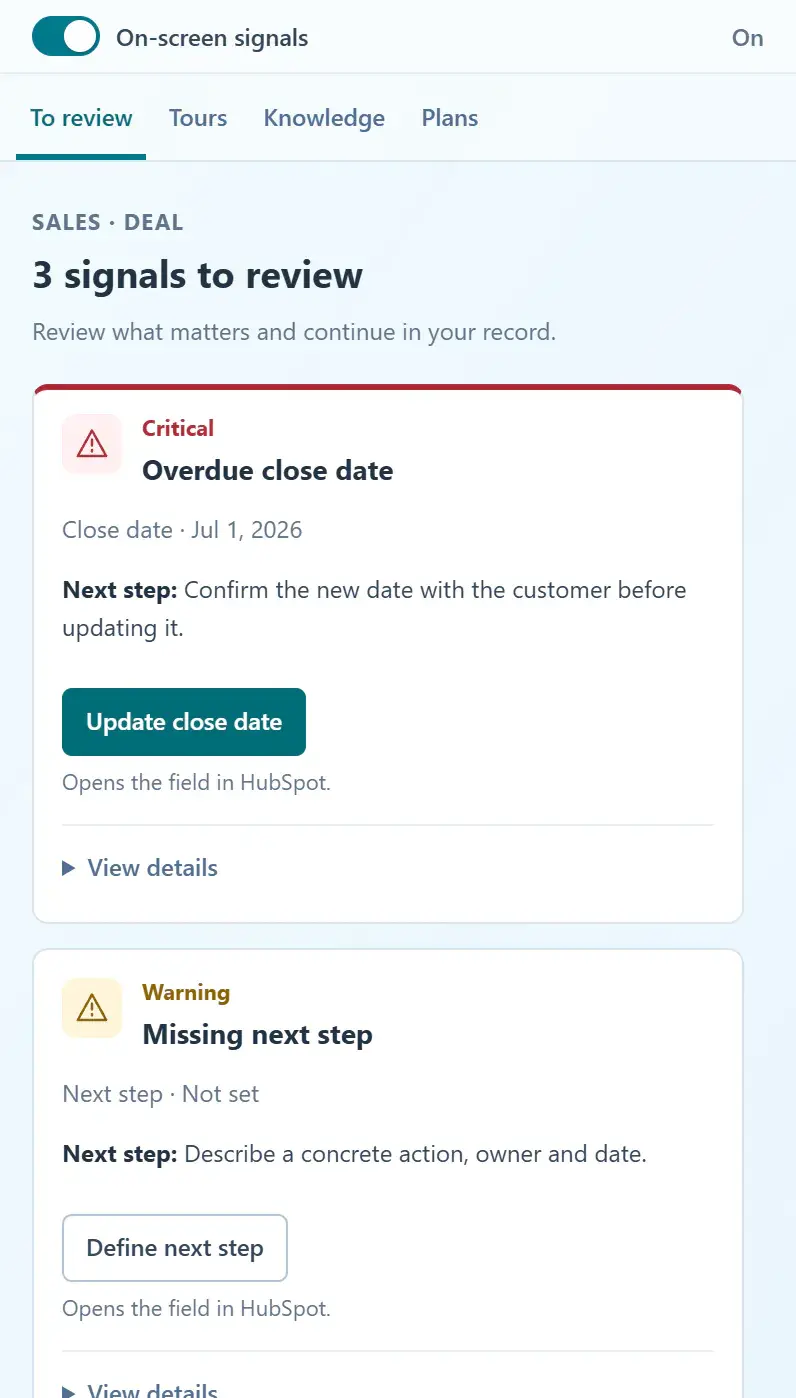
The signal appears on the deal, and the Side Panel explains what to review and opens the native editor. The details are in Understand a red close date.
What should you review this week?
- Save a view of open deals with a Close date before today.
- Read the last real conversation before touching the date.
- Decide: keep with evidence, move back a stage or close as lost.
- Record a next step with a date for every deal you keep.
- Fill in Closed lost reason for every deal you close.